
How to manage a pharma marketing budget without spreadsheet chaos
If budget season means hunting through five files called Budget_final_v3_USE_THIS.xlsx, you don't have a numbers problem — you have a system problem. Here's a simple one that works.

If you manage a pharmaceutical marketing budget, you know the feeling. It's planning season, and somewhere on a shared drive there are five files called Budget_2026, Budget_2026_v2, Budget_final, and the infamous Budget_final_USE_THIS.xlsx. Before you've made a single decision, you've lost an afternoon just working out which version is the real one.
I spent years as a pharma product manager, and budget management was the part of the job I dreaded most — not because the numbers were hard, but because the tools were working against me. Over time I worked out a system that kept my brand budget under control without the chaos. Here it is, step by step.
Why pharma marketing budgets are uniquely messy
A generic budget template never quite fits the way pharma teams actually spend. A few reasons:
- Many products, one pot. You're usually splitting a single budget across a portfolio of brands, each with its own share — so you need a product-level view, not one big total.
- Spend tied to HCPs and accounts. Congresses, meetings, materials and KOL activities mean you often need to know not just the category of a spend, but the healthcare professional or account behind it.
- More than one currency. Regional congresses, international agencies and headquarter recharges drag foreign currencies into a budget that's reported in one base currency.
- Planned vs. actual, always. The number that matters isn't what you planned — it's the gap between plan and reality, tracked continuously so nothing surprises you at quarter-end.
- Compliance is watching. Pharma spend is scrutinised closely (think the ABPI Code and transparency expectations), so clean, defensible records aren't a nice-to-have.
Spreadsheets can technically do all of this. But they do it through fragile formulas, copy-paste errors and version confusion — which is exactly where the afternoon goes.
A simple system that actually works
1. Keep one source of truth
The single biggest fix costs nothing: stop emailing spreadsheets around. Decide on one place where the budget lives, and make it the only place. Every figure — planned and actual — goes there. The moment there are two copies, there's no truth, only a guess.
2. Budget top-down: product first, then category
Start from the total budget and allocate it to each product as a share of the whole. Then, within each product, split that amount across your spend categories — congresses and events, digital, print and promotion, samples and detailing, KOL activities. Now every pound or euro has a home before it's spent, and you can see at a glance which product is carrying the budget.
3. Log every expense as it happens — not at month-end
This is the discipline that makes everything else easy. The moment a spend is committed, record it with the details you'll later wish you had: product, category, HCP or account, amount, currency, date and a short note. Logging as you go turns the dreaded month-end reconciliation into a five-minute check instead of a forensic investigation.
4. Track planned vs. actual continuously
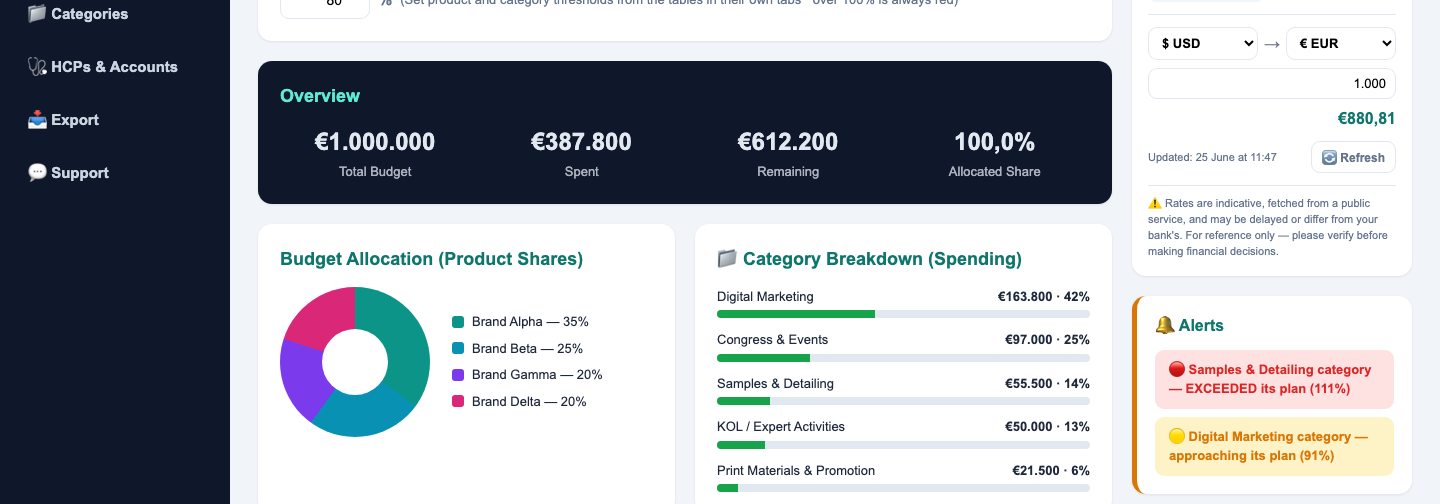
Keep a live view of three numbers per product and category: planned, spent and remaining. The gap is where decisions get made. When you can see that one product is at 40% spend in Q3 while another is already at 95%, you can shift, pause or push before it becomes a problem you have to explain.
5. Set thresholds and let the system warn you
Don't wait for an overspend to find out about it. Decide on an alert level — say 80% of a budget — and let a clear, visual warning flag any product, category or total that's getting close. Catching a creeping overrun in week two is a quiet adjustment; catching it at quarter-end is a difficult conversation.
6. Handle currency once, at the point of entry
Foreign-currency spend causes most budget errors. The fix is to convert it once, using the exchange rate on the day, and store both the original amount and the converted value. Then every report rolls up cleanly into your base currency, and you never have to re-do the maths.
7. Report in a format management trusts
Finally, make it effortless to hand a clean summary to management — a tidy Excel export or a one-page report, not a screenshot of a spreadsheet. When the numbers are already organised by product, category and period, reporting stops being a project of its own.
The takeaway
You don't need a finance degree or an enterprise system to keep a pharma marketing budget under control. You need three things: one source of truth, expenses logged as they happen, and a live planned-vs-actual view that warns you early. Everything else is detail.
The goal isn't a prettier spreadsheet. It's never having to ask "which file is the latest one?" again.
This is exactly the system I always wished I had — so eventually I built it. If the spreadsheet chaos sounds familiar, you might find it useful too.
Meet RxSpend
A private, offline marketing budget tracker built for pharma — product & category budgets, multi-currency, HCP/account tracking and over-budget alerts, all in a single file. Your figures never leave your computer.
Explore RxSpend → Try the demo (no signup)